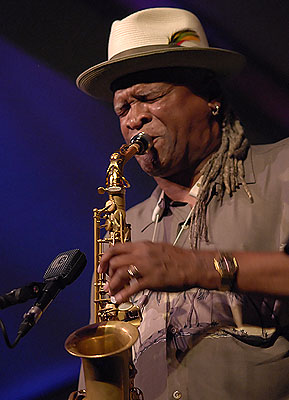
Bobby Watson
Foto: ataelw, CC BY 2.0, via Wikimedia Commons

Saxophonisten · * 1953

Bobby Watson

US-amerikanischer Jazzsaxophonist

Geboren
23. August 1953
Lawrence
Land
Vereinigte Staaten
Plattenlabels
Columbia Records, Blue Note, Roulette Records, Inc., Red Records, Smoke Sessions Records
Diskografie
27 Alben

Biografie

Bobby Watson ist ein Jazzmusiker (Saxophon und Altsaxophon). Bobby Watson wurde am 23. August 1953 in Lawrence geboren. Stilistisch wird die Musik meist Jazz und Post bop zugeordnet. Plattenlabels: Columbia Records, Blue Note, Roulette Records, Inc. und Red Records. Die Diskografie umfasst hier 27 Alben, von „Gumbo“ (1983) bis „Back Home in Kansas City“ (2022). Zu den Auszeichnungen zählen Kansas Music Hall of Fame (2011).

Robert „Bobby“ Watson (* 23. August 1953 in Lawrence, Kansas) ist ein amerikanischer Postbop-Altsaxophonist, Komponist, Produzent und Hochschullehrer.

Den vollständigen Artikel auf Wikipedia lesen ↗ · Aus Wikipedia, der freien Enzyklopädie (CC BY-SA 4.0)

Diskografie

Studio- und Livealben

Gumbo 1983 · Evidence Perpetual Groove 1984 · Live · Red Records Advance 1985 · Live · enja Appointment in Milano 1985 · Red Records Love Remains 1986 · Red Records Monk's Visit 1987 · Live · HEP Records Round Trip 1987 · Red Records Naima's Love Song 1988 · DIW No Question About It 1988 · Blue Note The Year Of The Rabbit 1989 · New Note The Inventor 1990 · Blue Note Present Tense 1992 · Columbia Jewel 1993 · Evidence Tailor Made 1993 · Columbia This Little Light of Mine 1993 · Red Records Midwest Shuffle 1994 · Live · Columbia Beatitudes 1997 · Evidence Quiet as It's Kept 1999 · Red Records Live & Learn 2001 · Palmetto Records A Balance of Light 2003 · Invisible Music Records From The Heart 2007 · Palmetto Records At Ease 2009 · Cowbell Music
Everlasting 2009
Check Cashing Day 2013 · Lafiya Music Made In America 2017 · Smoke Sessions Records Keepin' It Real 2020 · Smoke Sessions Records Back Home in Kansas City 2022 · Smoke Sessions Records

Spielt außerdem auf

Alben, auf denen Bobby Watson als Sideman mitwirkt

1970 M.F. Horn — Maynard Ferguson baritone saxophone
1990 That Holiday Feelin' — Joe Williams alto saxophone, instrument arranger
1992 In This Korner — Art Blakey alto saxophone
1992 New York Stories; Vol.1 — Danny Gatton alto saxophone
1994 All My Tomorrows — Grover Washington, Jr. alto saxophone
1995 Bop 'n' Blues — Cornell Dupree saxophone
1996 The Grand Encounter — Dianne Reeves alto saxophone
1996 A Piece for My Peace — John Hicks alto saxophone
1997 Master of the Stratosphere — Maynard Ferguson baritone saxophone
2001 Blakey's Theme — Wynton Marsalis & Art Blakey & The Jazz Messengers alto saxophone
2001 Round 'Bout Midnight — Wynton Marsalis alto saxophone
2001 Moanin' — Art Blakey & The Jazz Messengers featuring Wynton Marsalis alto saxophone
2005 Art Blakey and the Jazz Messengers — Art Blakey & The Jazz Messengers featuring Wynton Marsalis alto saxophone

Auszeichnungen

Häufige Fragen

Welches Instrument spielt Bobby Watson?

Bobby Watson ist bekannt für Saxophon und Altsaxophon.

Wann und wo wurde Bobby Watson geboren?

Bobby Watson wurde 23. August 1953 in Lawrence geboren.

Was sind die bekanntesten Alben von Bobby Watson?

In unserer Datenbank finden sich unter anderem Gumbo (1983), Perpetual Groove (1984), Advance (1985), Appointment in Milano (1985) und Love Remains (1986).

Weblinks

Daten aus offenen Quellen zusammengestellt; siehe Quellenangaben unten. Fehler entdeckt? Schreiben Sie uns.

Latest posts

  1. How to Improve Saxophone Skills Through Targeted Practice
  2. The 80/20 Rule in Piano Practice for Faster Results
  3. How to Create Jazz Music A Practical Approach to Crafting
  4. How to Choose Jazz Scales with Practical Examples
  5. What Is a Jazz Lead Sheet and How Do Musicians Use It
  6. Evaluating Jazz Syncopation Sources and Rhythmic Analysis
  7. Instruments of Bossa Nova Essential Tools for the Sound
  8. Why Is Improv Important in Jazz and How It Defines the Genre
  9. How to Memorize Jazz Standards Efficiently
  10. What Is the Most Well-Known Jazz Standard and Why It Wins