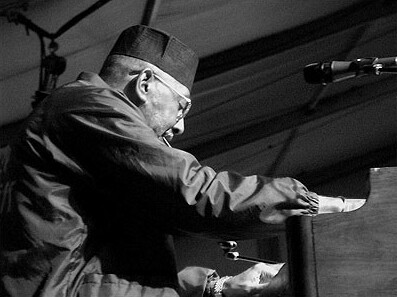
Jimmy McGriff
Foto: Atael Weissman, CC BY-SA 3.0, via Wikimedia Commons

Organisten · 1936–2008

Jimmy McGriff

Amerikanischer Soul- und Jazz-Organist

Geboren
3. April 1936
Germantown
Gestorben
24. Mai 2008
Voorhees Township
Land
Vereinigte Staaten
Aktiv
1960–
Plattenlabels
Blue Note, Groove Merchant
Diskografie
53 Alben

Biografie

Jimmy McGriff war ein Jazzmusiker (Orgel). Jimmy McGriff wurde am 3. April 1936 in Germantown geboren und starb am 24. Mai 2008 in Voorhees Township. Stilistisch wird die Musik meist Jazz, Blues und Hard Bop zugeordnet. Plattenlabels: Blue Note und Groove Merchant. Die Diskografie umfasst hier 53 Alben, von „I've Got a Woman“ (1962) bis „McGriff Avenue“ (2002).

James Harrell McGriff (* 3. April 1936 in Philadelphia, Pennsylvania; † 24. Mai 2008 ebenda) war ein amerikanischer Jazz- und Soul-Organist an der Hammond-Orgel, der zeitweise auch anderen Stilen wie Rhythm and Blues und Funk nachging.

Den vollständigen Artikel auf Wikipedia lesen ↗ · Aus Wikipedia, der freien Enzyklopädie (CC BY-SA 4.0)

Diskografie

Studio- und Livealben

I've Got a Woman 1962 · Sue Records At The Organ 1963 At the Apollo 1963 · Live · Sue Records Christmas with Jimmy McGriff 1963 · Sue Records Inc. One Of Mine 1963 · Sue Records Inc. Topkapi 1964 · Sue Records Blues for Mr. Jimmy 1965 · Sue Records Inc. A Bag Full Of Soul 1966 · Solid State Records Cherry 1966 · United Artists Live Where The Action's At 1966 · Live · Veep The Big Band 1966 · Solid State Records A Bag Full of Blues 1967 · Solid State Records I've Got a New Woman 1968 A Thing to Come By 1969 · Solid State Records Step 1 1969 · Solid State Records The Way You Look Tonight 1969 · Solid State Records Electric Funk 1970 · Blue Note Something To Listen To 1970 · Blue Note The Dudes Doin’ Business 1970 · Capitol Records Black Pearl 1971 · Live Black and Blues 1971 Groove Grease 1971 · Groove Merchant Jimmy Mcgriff/Junior Parker 1971 · Live · United Artists Soul Sugar 1971 · Capitol Records Let's Stay Together 1972 · Groove Merchant Concert Friday the 13th, Cook County Jail 1973 · Live · Groove Merchant The Main Squeeze 1974 · Groove Merchant Red Beans 1976 · Groove Merchant The Mean Machine 1976 · Groove Merchant Tailgunner 1977 · Lester Radio Corporation Outside Looking In 1978 City Lights 1981 · Jazz America Marketing Fly Dude 1982 Movin' Upside the Blues 1982 · Jazz America Marketing The Groover 1982 · Jazz America Marketing Skywalk 1984 · Milestone State Of The Art 1985 · Milestone The Starting Five 1987 · Milestone Blue to the Bone 1988 You Ought to Think About Me 1990 · Headfirst Records In a Blue Mood 1991 · Headfirst Records McGriff’s Blues 1994 · K‐tel Right Turn on Blue 1994 · Telarc Jazz Blues Groove 1996 · Telarc Jazz The Dream Team 1997 · Milestone Tribute to Basie 1997 · LRC Ltd. Straight Up 1998 McGriff's House Party 2000 · Milestone 100% Pure Funk 2001 · LRC Ltd. Feelin' It 2001 · Milestone McGriff Avenue 2002 · Milestone Countdown Stump Juice

Spielt außerdem auf

Alben, auf denen Jimmy McGriff als Sideman mitwirkt

Auf Spotify anhören

Häufige Fragen

Welches Instrument spielte Jimmy McGriff?

Jimmy McGriff ist bekannt für Orgel.

Wann und wo wurde Jimmy McGriff geboren?

Jimmy McGriff wurde 3. April 1936 in Germantown geboren.

Was sind die bekanntesten Alben von Jimmy McGriff?

In unserer Datenbank finden sich unter anderem I've Got a Woman (1962), At The Organ (1963), At the Apollo (1963), Christmas with Jimmy McGriff (1963) und One Of Mine (1963).

Weblinks

Daten aus offenen Quellen zusammengestellt; siehe Quellenangaben unten. Fehler entdeckt? Schreiben Sie uns.

Latest posts

  1. Evaluating Jazz Syncopation Sources and Rhythmic Analysis
  2. Instruments of Bossa Nova Essential Tools for the Sound
  3. Why Is Improv Important in Jazz and How It Defines the Genre
  4. How to Memorize Jazz Standards Efficiently
  5. What Is the Most Well-Known Jazz Standard and Why It Wins
  6. What Does the ø Symbol Mean in Jazz Theory
  7. Examples of Bebop Jazz and Essential Listening Tracks
  8. What Is a Basic Drumming Pattern Called and How It Works
  9. How to Ear Train Effectively for Better Musicianship
  10. How to Notate a Tritone Substitution in Jazz Charts