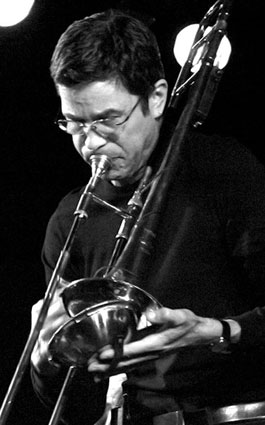
Trompeter · * 1952
Ray Anderson
US-amerikanischer Jazzposaunist
- Geboren
- 16. Oktober 1952
Chicago - Aktiv
- 1973–
- Diskografie
- 24 Alben
Biografie
Ray Anderson ist ein Jazzmusiker (Trompete, Posaune, Schlaginstrument und Singstimme). Ray Anderson wurde am 16. Oktober 1952 in Chicago geboren. Stilistisch wird die Musik meist Jazz und Jazzfunk zugeordnet. Plattenlabels: Enja und CIMP. Die Diskografie umfasst hier 24 Alben, von „Harrisburg Half Life“ (1980) bis „12 Stages of Spiritual Alchemy“ (2025). Zu den Auszeichnungen zählen Guggenheim-Stipendium (2001).
Ray Robert Anderson (* 16. Oktober 1952 in Chicago, Illinois) ist ein US-amerikanischer Jazzposaunist. Er hat einen unverkennbaren rotzigen Spielstil und ist bekannt für seine witzigen Kompositionen. Er wurde von den Kritikern des Down-Beat-Magazins fünf Jahre hintereinander zum besten Posaunenspieler der Gegenwart gewählt.
Den vollständigen Artikel auf Wikipedia lesen ↗ · Aus Wikipedia, der freien Enzyklopädie (CC BY-SA 4.0)
Diskografie
Studio- und Livealben
Spielt außerdem auf
Alben, auf denen Ray Anderson als Sideman mitwirkt
| 1980 | Brahma — Barry Altschul Trio |
| 1981 | Composition 98 — Anthony Braxton |
| 1983 | The Ancestors — Tim Berne |
| 1984 | Electric Outlet — John Scofield |
| 1988 | Bordertown — Bennie Wallace |
| 1988 | Black Pastels — Hank Roberts |
| 1989 | Straight Ahead! — Barbara Dennerlein |
| 1990 | Performance (Quartet) 1979 — Anthony Braxton |
| 1991 | Little Wing — Lew Soloff |
| 1992 | That’s Me — Barbara Dennerlein |
| 1993 | Cosmopolitan Greetings — George Gruntz, Allen Ginsberg |
| 1994 | Conversations — Karl Berger |
| 1994 | Half a Lifetime — Fredy Studer, Christy Doran |
| 1995 | Creative Orchestra (Köln) 1978 — Anthony Braxton |
| 1995 | Take Off! — Barbara Dennerlein |
| 1998 | Irina — Barry Altschul Quartet |
| 1999 | Cosmopoly — Andreas Vollenweider |
| 1999 | Composition No. 94 for Three Instrumentalists (1980) — Anthony Braxton |
| 2003 | Nine Songs Together — Mark Dresser & Ray Anderson |
| 2015 | Trio (Florence) 1979 - 11.19 - 1 — Anthony Braxton |
| — | Another Time / Another Place — Barry Altschul |
Auszeichnungen
Auf Spotify anhören
Häufige Fragen
Welches Instrument spielt Ray Anderson?
Ray Anderson ist bekannt für Trompete, Posaune, Schlaginstrument und Singstimme.
Wann und wo wurde Ray Anderson geboren?
Ray Anderson wurde 16. Oktober 1952 in Chicago geboren.
Was sind die bekanntesten Alben von Ray Anderson?
In unserer Datenbank finden sich unter anderem Harrisburg Half Life (1980), Right Down Your Alley (1984), Old Bottles - New Wine (1985), You Be (1986) und It Just So Happens (1987).
Weblinks
- en.wikipedia.org ↗
- de.wikipedia.org ↗
- wikidata.org ↗
- musicbrainz.org ↗
- discogs.com ↗
- allmusic.com ↗
- rayanderson.org ↗
Daten aus offenen Quellen zusammengestellt; siehe Quellenangaben unten. Fehler entdeckt? Schreiben Sie uns.