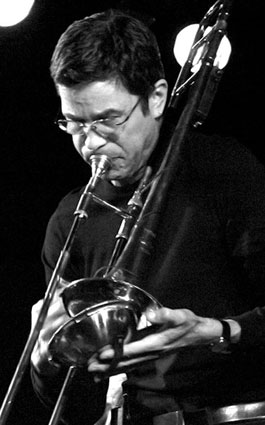
- Born
- 16 October 1952
Chicago - Country
- United States
- Active
- 1973–
- Record labels
- Enja Records, CIMP
- Discography
- 24 albums
Biography
Ray Anderson is a jazz musician who plays trumpet, trombone, percussion instrument and voice. Ray Anderson was born on 16 October 1952 in Chicago. The music is usually filed under jazz and jazz-funk. Record labels: Enja Records and CIMP. The discography here lists 24 albums, from “Harrisburg Half Life” (1980) to “12 Stages of Spiritual Alchemy” (2025). Honours include Guggenheim Fellowship (2001).
Ray Anderson (born October 16, 1952) is an American jazz trombonist.
Read the full article on Wikipedia ↗ · From Wikipedia, the free encyclopedia (CC BY-SA 4.0)
Discography
Studio and live albums
Also plays on
Albums where Ray Anderson is credited as a sideman
| 1980 | Brahma — Barry Altschul Trio |
| 1981 | Composition 98 — Anthony Braxton |
| 1983 | The Ancestors — Tim Berne |
| 1984 | Electric Outlet — John Scofield |
| 1988 | Bordertown — Bennie Wallace |
| 1988 | Black Pastels — Hank Roberts |
| 1989 | Straight Ahead! — Barbara Dennerlein |
| 1990 | Performance (Quartet) 1979 — Anthony Braxton |
| 1991 | Little Wing — Lew Soloff |
| 1992 | That’s Me — Barbara Dennerlein |
| 1993 | Cosmopolitan Greetings — George Gruntz, Allen Ginsberg |
| 1994 | Conversations — Karl Berger |
| 1994 | Half a Lifetime — Fredy Studer, Christy Doran |
| 1995 | Creative Orchestra (Köln) 1978 — Anthony Braxton |
| 1995 | Take Off! — Barbara Dennerlein |
| 1998 | Irina — Barry Altschul Quartet |
| 1999 | Cosmopoly — Andreas Vollenweider |
| 1999 | Composition No. 94 for Three Instrumentalists (1980) — Anthony Braxton |
| 2003 | Nine Songs Together — Mark Dresser & Ray Anderson |
| 2015 | Trio (Florence) 1979 - 11.19 - 1 — Anthony Braxton |
| — | Another Time / Another Place — Barry Altschul |
Awards
Listen on Spotify
Frequently asked questions
What instrument does Ray Anderson play?
Ray Anderson is known for playing trumpet, trombone, percussion instrument and voice.
When and where was Ray Anderson born?
Ray Anderson was born 16 October 1952 in Chicago.
What are Ray Anderson's best-known albums?
Albums in our database include Harrisburg Half Life (1980), Right Down Your Alley (1984), Old Bottles - New Wine (1985), You Be (1986) and It Just So Happens (1987).
External links
- en.wikipedia.org ↗
- de.wikipedia.org ↗
- wikidata.org ↗
- musicbrainz.org ↗
- discogs.com ↗
- allmusic.com ↗
- rayanderson.org ↗
Data compiled from open sources; see the source links below. Spotted an error? Let us know.