Jazz musicians: bongo
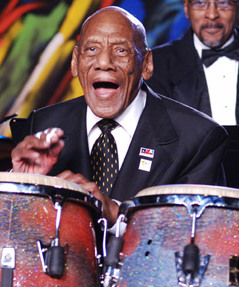
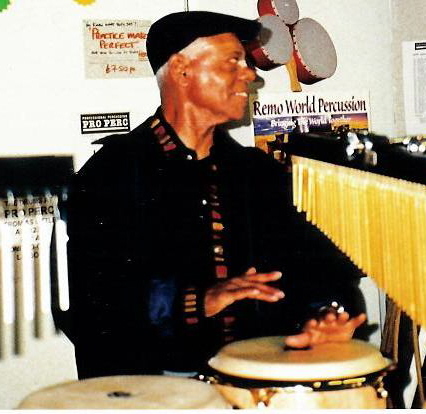
3 jazz musicians in the atlas play bongo, including Cándido Camero, Armando Peraza and Jack Costanzo. Open a profile for dates, discography and line-ups.
Bongos (Spanish: bongó) are an Afro-Cuban percussion instrument consisting of a pair of small open bottomed hand drums of different sizes. The pair consists of the larger hembra (lit. 'female') and the smaller macho (lit. 'male'), which are joined by a wooden bridge. They are played with both hands and usually held between the legs, although in some cases, as in classical music, they may be played with sticks or mounted on stands. Bongos are mainly employed in the rhythm section of son cubano and salsa ensembles, often alongside other drums such as the larger congas and the stick-struck timbales. In these groups, the bongo player is known as bongosero (or bongocero) and often plays a continuous eight-stroke pattern called martillo (lit. 'hammer') as well as more rhythmically free parts, providing improvisatory flourishes and rhythmic counterpoint.
Read the full article on Wikipedia ↗ · From Wikipedia, the free encyclopedia (CC BY-SA 4.0)

Latest posts
- Evaluating Jazz Syncopation Sources and Rhythmic Analysis
- Instruments of Bossa Nova Essential Tools for the Sound
- Why Is Improv Important in Jazz and How It Defines the Genre
- How to Memorize Jazz Standards Efficiently
- What Is the Most Well-Known Jazz Standard and Why It Wins
- What Does the ø Symbol Mean in Jazz Theory
- Examples of Bebop Jazz and Essential Listening Tracks
- What Is a Basic Drumming Pattern Called and How It Works
- How to Ear Train Effectively for Better Musicianship
- How to Notate a Tritone Substitution in Jazz Charts