Jazz musicians: oud
8 jazz musicians in the atlas play oud, including Rabih Abou-Khalil, Dhafer Youssef, Joseph Tawadros, Majid Bekkas and Titi Robin. Open a profile for dates, discography and line-ups.
The oud ( OOD; Arabic: عُود, romanized: ʿūd, pronounced [ʕuːd]) is a Middle Eastern short-neck lute-type, pear-shaped, fretless stringed instrument (a chordophone in the Hornbostel–Sachs classification of instruments), usually with 11 strings grouped in six courses, but some models have five or seven courses, with 10 or 13 strings respectively. The oud is similar to other types of lute, and to Western lutes which developed out of the Medieval Islamic oud. Similar instruments have been used in the Middle East, some predating Islam, such as the barbat from Persia. Different versions of the oud are used in Arabia, Turkey, and other Middle Eastern and Balkan regions. The oud, as a fundamental difference with the western lute, has no frets and a smaller neck. It is the direct successor of the Persian barbat lute. The oldest surviving oud is thought to be in Brussels, at the Museum of Musical Instruments.
Read the full article on Wikipedia ↗ · From Wikipedia, the free encyclopedia (CC BY-SA 4.0)
 Rabih Abou-Khalil
b. 1957 · Lebanese musician
 Dhafer Youssef
b. 1967 · Tunisian musician
 Joseph Tawadros
b. 1983 · Egyptian-born Coptic Australian multi-instrumentalist and…
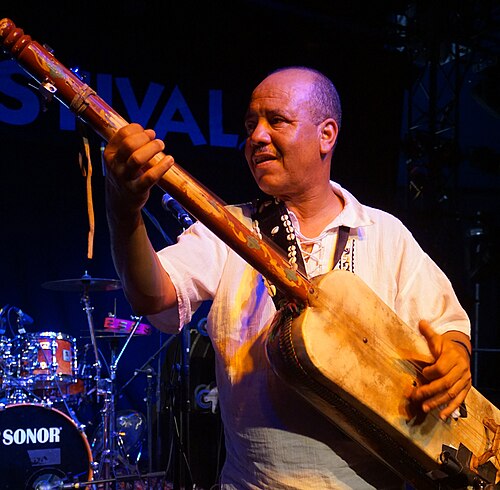 Majid Bekkas
b. 1957 · Moroccan Gnawa musician, guembri and oud player, composer
 Titi Robin
b. 1957 · French musician
Ahmed Abdul-Malik
1927–1993 · American bassist (1927–1993)
Lloyd Miller
1938–2024 · American jazz musician (1938–2024)
Ara Dinkjian
b. 1958 · Armenian-American musician
Latest posts
- Evaluating Jazz Syncopation Sources and Rhythmic Analysis
- Instruments of Bossa Nova Essential Tools for the Sound
- Why Is Improv Important in Jazz and How It Defines the Genre
- How to Memorize Jazz Standards Efficiently
- What Is the Most Well-Known Jazz Standard and Why It Wins
- What Does the ø Symbol Mean in Jazz Theory
- Examples of Bebop Jazz and Essential Listening Tracks
- What Is a Basic Drumming Pattern Called and How It Works
- How to Ear Train Effectively for Better Musicianship
- How to Notate a Tritone Substitution in Jazz Charts