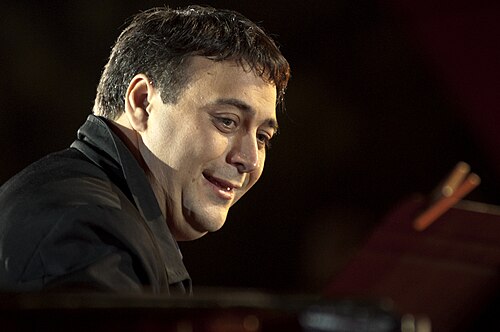
- Born
- 20 February 1970
Huy - Country
- Belgium
- Active
- 1980–
- Discography
- 8 albums
Biography
Éric Legnini is a jazz musician who plays piano, musical keyboard and Rhodes piano. Éric Legnini was born on 20 February 1970 in Huy. The music is usually filed under jazz. The discography here lists 8 albums, from “Rhythm Sphere” (1985) to “Six Strings Under” (2019).
Éric Legnini (born 20 February 1970 in Huy, near Liège, Belgium) is a Belgian jazz pianist and bandleader of the Éric Legnini Trio. Legnini was born into an artistic family from Italy. The family immigrated to Belgium, where he started playing the piano at age 6 and initiated in jazz in his teens. In 1988 he traveled to the United States for two years to study American jazz. He returned as a teacher of jazz piano at the Brussels Royal Conservatory of Music, where he met Jacques Pelzer. The result was the Pelzer album Never Let Me Go with guest stars Barney Wilen and Michel Graillier. He started to play piano in the Stefano di Battista Quartet. In the 1990s, he worked with Flavio Boltro (trumpet) and Stefano Di Battista (saxophone) forming the jazz ensemble Éric Legnini Trio that caught attention in the 1990s.
Read the full article on Wikipedia ↗ · From Wikipedia, the free encyclopedia (CC BY-SA 4.0)
Discography
Studio and live albums
Also plays on
Albums where Éric Legnini is credited as a sideman
Listen on Spotify
Frequently asked questions
What instrument does Éric Legnini play?
Éric Legnini is known for playing piano, musical keyboard and Rhodes piano.
When and where was Éric Legnini born?
Éric Legnini was born 20 February 1970 in Huy.
What are Éric Legnini's best-known albums?
Albums in our database include Rhythm Sphere (1985), Essentiels (1990), Natural Balance (1991), The Vox (2011) and Hummingbiiird (2013).
External links
- en.wikipedia.org ↗
- de.wikipedia.org ↗
- wikidata.org ↗
- musicbrainz.org ↗
- discogs.com ↗
- allmusic.com ↗
- ericlegnini.com ↗
Data compiled from open sources; see the source links below. Spotted an error? Let us know.