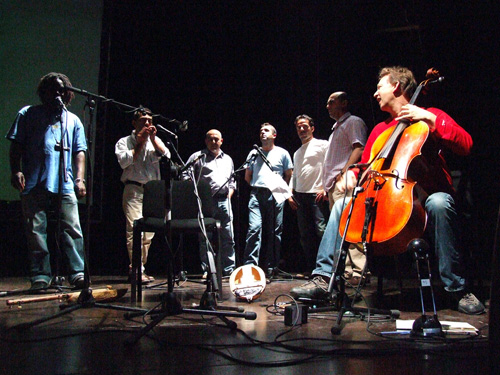
Biography
Mola Sylla is a jazz musician who plays percussion instrument, violin, mbira and xalam. Mola Sylla was born in 1956 in Dakar.
Mola Sylla (born Dakar, Senegal, 1956) is a Senegalese musician. He moved to Europe in 1987 and lives in Amsterdam, Netherlands. He is a singer and plays such traditional African instruments as the mbira, kongoma (Senegalese lamellophone), xalam, and kalimba. Sylla has collaborated with a wide variety of musicians, including in jazz and cross-cultural settings. He has worked with Ernst Reijseger, with whom he composed the score to Werner Herzog's 2005 film The Wild Blue Yonder. He is a founding member of the groups Senemali (a collaboration between Senegalese and Malian musicians) and VeDaKi (formerly Vershki da Koreshki, a quartet made up of Senegalese, Russian, and Indian musicians).
Read the full article on Wikipedia ↗ · From Wikipedia, the free encyclopedia (CC BY-SA 4.0)
Also plays on
Albums where Mola Sylla is credited as a sideman
Frequently asked questions
What instrument does Mola Sylla play?
Mola Sylla is known for playing percussion instrument, violin, mbira and xalam.
When and where was Mola Sylla born?
Mola Sylla was born 1956 in Dakar.
External links
Data compiled from open sources; see the source links below. Spotted an error? Let us know.