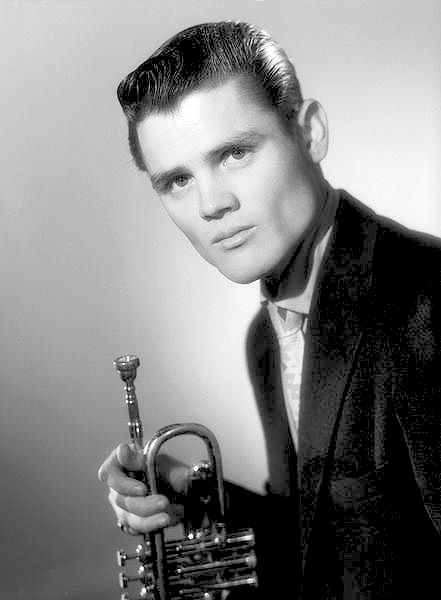
Trumpet solo · 1955
Chet Baker: Let's Get Lost
- Key
- C major
- Tempo
- 158 BPM MEDIUM UP
- Rhythm feel
- Swing
- Style
- Cool
- Choruses
- 1
- Form
- A8B8A8C8
Chet Baker's solo on “Let's Get Lost” has 142 notes in 49 seconds (2.9 notes per second), spanning 24 semitones from A3 to A5. The average tempo is 158 BPM with a swing feel. About 54% of the melodic motion is stepwise (one or two semitones).
Notes
142Notes
49sSolo length
2.9Notes per second
A3–A5Range (24 semitones)
54%Stepwise motion
Pitch-class distribution
C
C♯
D
E♭
E
F
F♯
G
A♭
A
B♭
B
Most frequent intervals
- -2 ×26
- +2 ×19
- -3 ×18
- +3 ×16
- +1 ×15
- -1 ×15
Changes played over
A1
B1
A2
C1
Record
- Record
- Let's Get Lost · Giants of Jazz · 1996
- Recorded
- 1955-03-07
- Line-up
- Chet Baker (tp); Russ Freeman (p); Carson Smith (b); Bob Neel (dr)
- Composer
- Loesser / McHugh
- Solo length
- 01:54-02:42
Source: Weimar Jazz Database, Jazzomat Research Project (HfM Weimar), ODbL 1.0.