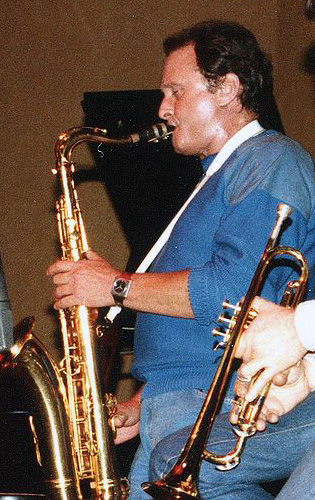
Tenor saxophone solo · 1963
Stan Getz: Insensatez
- Key
- A minor
- Tempo
- 128 BPM MEDIUM
- Rhythm feel
- Latin
- Style
- Cool
- Choruses
- 1
- Form
- A8B8C8D8
Stan Getz's solo on “Insensatez” has 155 notes in 61 seconds (2.5 notes per second), spanning 27 semitones from C3 to Eb5. The average tempo is 128 BPM with a latin feel. About 56% of the melodic motion is stepwise (one or two semitones).
Notes
155Notes
61sSolo length
2.5Notes per second
C3–Eb5Range (27 semitones)
56%Stepwise motion
Pitch-class distribution
C
C♯
D
E♭
E
F
F♯
G
A♭
A
B♭
B
Most frequent intervals
- -2 ×28
- +2 ×26
- +1 ×18
- +3 ×17
- -1 ×14
- -3 ×11
Changes played over
A1
B1
C1
D1
I1
Record
- Record
- Body and Soul · Universal · 2006
- Recorded
- 1963-02-08
- Line-up
- Stan Getz (ts); Maria Toledo (voc); Luiz Bonfa (g); Antonio Carlos Jobim (p); George Duvivier (b); Paulo Ferreira (perc); Jose Carlos (dr, perc)
- Composer
- Antonio Carlos Jobim, Vinicius De Moraes
- Solo length
- 01:16-02:18
Source: Weimar Jazz Database, Jazzomat Research Project (HfM Weimar), ODbL 1.0.