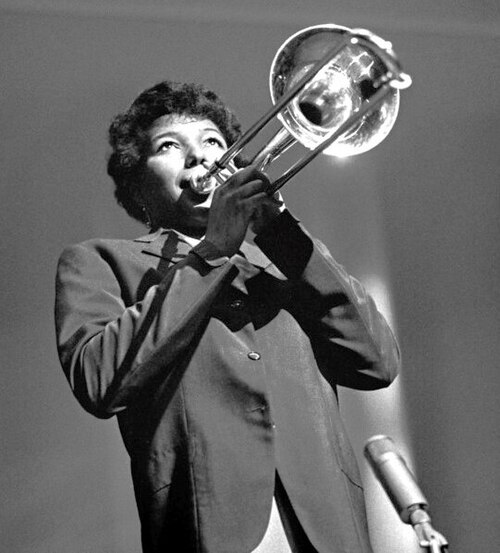
Melba Liston
Foto: Finnish Heritage Agency, CC BY-SA 4.0, via Wikimedia Commons

Trombonisti · 1926–1999

Melba Liston

Musicista statunitense

Nascita
13 gennaio 1926
Kansas City
Morte
23 aprile 1999
Los Angeles
Paese
Stati Uniti

Biografia

Melba Liston è stata una musicista jazz (trombone). Nata il 13 gennaio 1926 a Kansas City, morta il 23 aprile 1999 a Los Angeles. Lo stile è di solito associato a jazz. Tra i riconoscimenti: NEA Jazz Masters.

Melba Doretta Liston (Kansas City, 13 gennaio 1926 – Los Angeles, 23 aprile 1999) è stata una trombonista, arrangiatrice e compositrice statunitense. Fu la prima trombonista donna a suonare in big band negli anni '40 e '60, ma con il progredire della sua carriera divenne più conosciuta come arrangiatrice, soprattutto in collaborazione con il pianista Randy Weston.

Leggi la voce completa su Wikipedia ↗ · Da Wikipedia, l'enciclopedia libera (CC BY-SA 4.0)

Suona anche in

Album in cui Melba Liston compare come sideman

1956 World Statesman — Dizzy Gillespie trombone, arranger
1957 Dizzy in Greece — Dizzy Gillespie trombone, arranger
1957 Dizzy Gillespie's Big Band Jazz — Dizzy Gillespie trombone
1958 Out There With Betty Carter — Betty Carter trombone
1958 Little Niles — Randy Weston arranger, trombone
1959 The Birth of a Band — Quincy Jones trombone, arranger
1959 The Genius of Ray Charles — Ray Charles trombone
1959 Newport ’58 — Dinah Washington, Terry Gibbs, Max Roach & Don Elliott trombone
1959 Tales of Manhattan: The Cool Philosophy of Babs Gonzales — Babs Gonzales arranger, conductor
1960 I Dig Dancers — Quincy Jones trombone
1960 Uhuru Afrika — Randy Weston arranger
1960 Live at the Fivespot — Randy Weston arranger
1961 Quincy Jones and His Orchestra at Newport '61 — Quincy Jones trombone
1962 With The All-Star Big Band — Ray Brown Guest Artist Cannonball Adderley trombone
1962 Big Bags — Milt Jackson trombone
1962 Afro/American Sketches — Oliver Nelson Orchestra trombone
1962 The Soul of Hollywood — Junior Mance arranger, conductor
1963 The Body & The Soul — Freddie Hubbard trombone
1963 Any Number Can Win — Jimmy Smith trombone
1963 Music From the New African Nations featuring The Highlife — Randy Weston arranger
1964 Live And Swinging — Dakota Staton arranger
1965 And Then Again — Elvin Jones arranger, conductor
1966 Hold On, I’m Coming — Art Blakey arranger, trombone
1966 Jimmy & Wes: The Dynamic Duo — Jimmy Smith & Wes Montgomery trombone
1966 Hoochie Coochie Man — Jimmy Smith trombone
1966 Roll 'em: Shirley Scott Plays the Big Bands — Shirley Scott trombone
1967 A Mann & A Woman — Herbie Mann & Tamiko Jones arranger
1968 Heads Up! — Blue Mitchell arranger
1969 Further Adventures of Jimmy and Wes — Jimmy Smith and Wes Montgomery trombone
1970 I've Been There — Dakota Staton arranger

Premi

Dischi storici a 78 giri

  • Warm Mood Gerald Wilson and His Orchestra · Melba Liston · 1946 archive.org ↗
  • WARM MOOD GERALD WILSON · Melba Liston · 1946 archive.org ↗
  • WARM MOOD GERALD WILSON AND HIS ORCHESTRA · Melba Liston · 1946 archive.org ↗
  • Oh, Well! James Moody Quintet · Dexter Gordon · Melba Liston · Charlie Fox ·… · 1948 archive.org ↗
  • MISCHIEVOUS LADY DEXTER GORDON QUINTET · DEXTER GORDON · MELBA LISTON · CHARLIE FOX ·… · 1948 archive.org ↗
  • Lullaby In Rhythm Dexter Gordon Quintet · Dexter Gordon · Melba Liston · Charlie Fox ·… · 1949 archive.org ↗

Domande frequenti

Che strumento suonava Melba Liston?

Melba Liston è noto per trombone.

Quando e dove è nato Melba Liston?

Melba Liston è nato 13 gennaio 1926 a Kansas City.

Collegamenti esterni

Dati raccolti da fonti aperte; vedi i riferimenti qui sotto. Hai trovato un errore? Scrivici.

Latest posts

  1. How to Create Jazz Music A Practical Approach to Crafting
  2. How to Choose Jazz Scales with Practical Examples
  3. What Is a Jazz Lead Sheet and How Do Musicians Use It
  4. Evaluating Jazz Syncopation Sources and Rhythmic Analysis
  5. Instruments of Bossa Nova Essential Tools for the Sound
  6. Why Is Improv Important in Jazz and How It Defines the Genre
  7. How to Memorize Jazz Standards Efficiently
  8. What Is the Most Well-Known Jazz Standard and Why It Wins
  9. What Does the ø Symbol Mean in Jazz Theory
  10. Examples of Bebop Jazz and Essential Listening Tracks