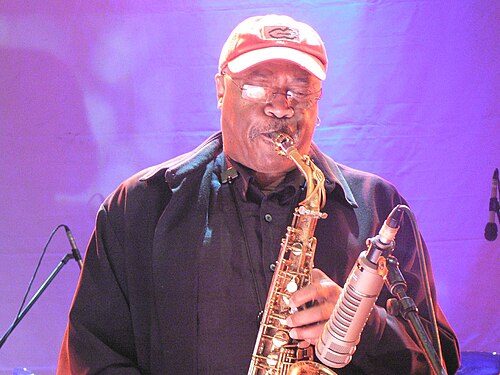
Oliver Lake
Foto: Andy Newcombe Farnborough, UK, CC BY-SA 2.0, via Wikimedia Commons

Saxophonisten · * 1942

Oliver Lake

US-amerikanischer Jazz-Saxophonist und Komponist

Geboren
14. September 1942
Marianna
Land
Vereinigte Staaten
Aktiv
1971–
Plattenlabels
Freedom
Diskografie
15 Alben

Biografie

Oliver Lake ist ein Jazzmusiker (Saxophon, Tenorsaxophon, Altsaxophon und Sopransaxophon). Oliver Lake wurde am 14. September 1942 in Marianna geboren. Stilistisch wird die Musik meist Jazz zugeordnet. Plattenlabels: Freedom. Die Diskografie umfasst hier 15 Alben, von „Heavy Spirits“ (1975) bis „Dance of The Evil Toys“ (2022). Zu den Auszeichnungen zählen Guggenheim-Stipendium und Doris Duke Performing Artist Award.

Oliver Eugene Lake (* 14. September 1942 in Marianna/Arkansas) ist ein US-amerikanischer Jazz-Saxophonist und Komponist.

Den vollständigen Artikel auf Wikipedia lesen ↗ · Aus Wikipedia, der freien Enzyklopädie (CC BY-SA 4.0)

Diskografie

Studio- und Livealben

Spielt außerdem auf

Alben, auf denen Oliver Lake als Sideman mitwirkt

1975 New York, Fall 1974 — Anthony Braxton tenor saxophone
1977 Enchance — Billy Hart alto saxophone, flute
1977 Point of No Return — The World Saxophone Quartett saxophone
1979 Steppin’ With the World Saxophone Quartet — The World Saxophone Quartet saxophone
1980 Are You Glad to Be in America? — James Blood Ulmer alto saxophone
1981 Free Lancing — James Blood Ulmer alto saxophone
1981 W.S.Q. — World Saxophone Quartet saxophone
1982 Revue — World Saxophone Quartet saxophone
1984 Live in Zürich — World Saxophone Quartet woodwind
1986 World Saxophone Quartet Plays Duke Ellington — World Saxophone Quartet alto saxophone
1986 Live at Brooklyn Academy of Music — World Saxophone Quartet saxophone
1987 Dances and Ballads — World Saxophone Quartet saxophone, soprano saxophone
1987 The Art of the Saxophone — Bennie Wallace alto saxophone
1989 Rhythm and Blues — World Saxophone Quartet saxophone
1991 Metamorphosis — World Saxophone Quartet woodwind
1994 Breath of Life — World Saxophone Quartet alto saxophone
1994 Moving Right Along — World Saxophone Quartet saxophone
1996 Four Now — World Saxophone Quartet with African Drums alto saxophone
1996 Takin’ It 2 the Next Level — World Saxophone Quartet alto saxophone
1997 Who Used to Dance — Abbey Lincoln alto saxophone
1998 Selim Sivad: A Tribute to Miles Davis — World Saxophone Quartet feat. Jack DeJohnette woodwind
1998 Global Mantras — Pheeroan akLaff alto saxophone
1999 M’Bizo — World Saxophone Quartet alto saxophone
1999 A New Organization — Borah Bergman / Oliver Lake alto saxophone, soprano saxophone, saxophone
2000 Requiem for Julius — World Saxophone Quartet alto saxophone
2000 Hicks Time — John Hicks producer
2001 25th Anniversary: The New Chapter — World Saxophone Quartet alto saxophone
2002 Steppenwolf — World Saxophone Quartet alto saxophone
2003 One Atmosphere — Julius Hemphill flute, saxophone
2004 Experience — World Saxophone Quartet saxophone, arranger

Mitglied von

Auszeichnungen

Häufige Fragen

Welches Instrument spielt Oliver Lake?

Oliver Lake ist bekannt für Saxophon, Tenorsaxophon, Altsaxophon und Sopransaxophon.

Wann und wo wurde Oliver Lake geboren?

Oliver Lake wurde 14. September 1942 in Marianna geboren.

Was sind die bekanntesten Alben von Oliver Lake?

In unserer Datenbank finden sich unter anderem Heavy Spirits (1975), Holding Together (1976), NTU: Point From Which Creation Begins (1976), Shine! (1979) und Gallery (1986).

Weblinks

Daten aus offenen Quellen zusammengestellt; siehe Quellenangaben unten. Fehler entdeckt? Schreiben Sie uns.

Latest posts

  1. How to Improve Saxophone Skills Through Targeted Practice
  2. The 80/20 Rule in Piano Practice for Faster Results
  3. How to Create Jazz Music A Practical Approach to Crafting
  4. How to Choose Jazz Scales with Practical Examples
  5. What Is a Jazz Lead Sheet and How Do Musicians Use It
  6. Evaluating Jazz Syncopation Sources and Rhythmic Analysis
  7. Instruments of Bossa Nova Essential Tools for the Sound
  8. Why Is Improv Important in Jazz and How It Defines the Genre
  9. How to Memorize Jazz Standards Efficiently
  10. What Is the Most Well-Known Jazz Standard and Why It Wins