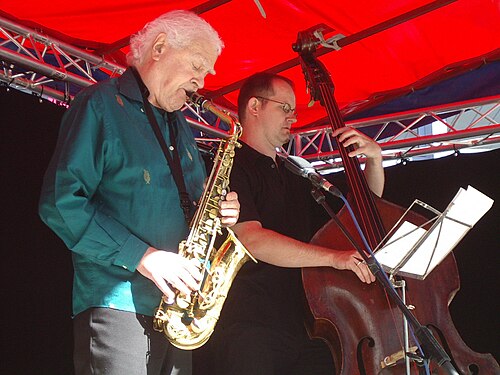
Bassists · b. 1961
Dieter Ilg
German bassist
- Born
- 30 September 1961
Offenburg - Country
- Germany
- Discography
- 13 albums
Biography
Dieter Ilg is a jazz musician who plays double bass, percussion instrument and acoustic bass guitar. Dieter Ilg was born on 30 September 1961 in Offenburg. The music is usually filed under jazz and rock music. The discography here lists 13 albums, from “Dieter Ilg, John Schröder, Wolfgang Haffner” (1989) to “Motherland” (2025). Honours include Jazz-Preis Baden-Württemberg (1988) and Reinhold Schneider Prize (2006).
Dieter Josef Ilg (born September 30, 1961, in Offenburg) is a German jazz double-bassist. He worked early in his career with Joe Viera in the early 1980s, then with Randy Brecker, the WDR Big Band, Bennie Wallace, Albert Mangelsdorff, Wolfgang Dauner, Charlie Mariano, Marc Copland, Jeff Hirshfield, Wolfgang Muthspiel and others. He has taught at Rockschool Freiburg and the Freiburg Conservatory.
Read the full article on Wikipedia ↗ · From Wikipedia, the free encyclopedia (CC BY-SA 4.0)
Discography
Studio and live albums
Also plays on
Albums where Dieter Ilg is credited as a sideman
Awards
- 1988 Jazz-Preis Baden-Württemberg
- 2006 Reinhold Schneider Prize
Frequently asked questions
What instrument does Dieter Ilg play?
Dieter Ilg is known for playing double bass, percussion instrument and acoustic bass guitar.
When and where was Dieter Ilg born?
Dieter Ilg was born 30 September 1961 in Offenburg.
What are Dieter Ilg's best-known albums?
Albums in our database include Dieter Ilg, John Schröder, Wolfgang Haffner (1989), Summerhill (1991), Fieldwork (1998), Due (2005) and Bass (2008).
External links
Data compiled from open sources; see the source links below. Spotted an error? Let us know.