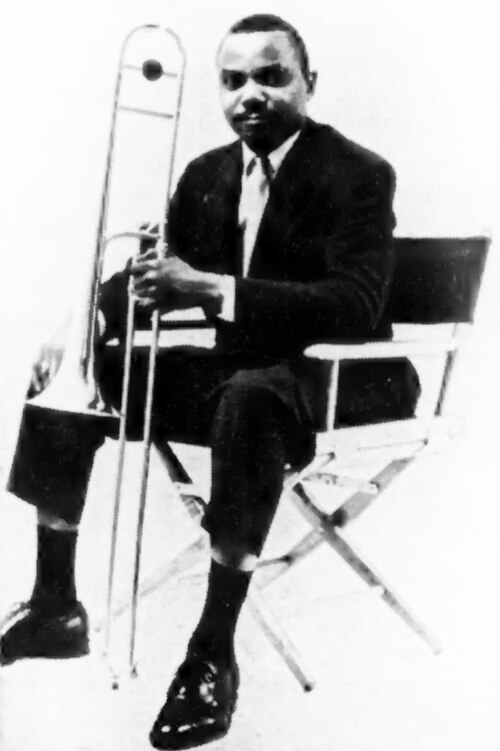
Trombone solo · 1949
J.J. Johnson: Elora
- Key
- B♭ major
- Tempo
- 197 BPM UP
- Rhythm feel
- Swing
- Style
- Bebop
- Choruses
- 1
- Form
- A8A8B8C8
J.J. Johnson's solo on “Elora” has 140 notes in 39 seconds (3.6 notes per second), spanning 24 semitones from D3 to D5. The average tempo is 197 BPM with a swing feel. About 57% of the melodic motion is stepwise (one or two semitones).
Notes
140Notes
39sSolo length
3.6Notes per second
D3–D5Range (24 semitones)
57%Stepwise motion
Pitch-class distribution
C
C♯
D
E♭
E
F
F♯
G
A♭
A
B♭
B
Most frequent intervals
- -2 ×39
- -1 ×25
- -3 ×15
- +1 ×9
- +3 ×9
- +4 ×9
Changes played over
A1
A2
B1
A3
I1
Record
- Record
- Quadromania Jazz Edition, Sonny Stitt, One O'Clock Jump, CD 1 · Membran Music Ltd. · 2005
- Recorded
- 1949-10-17
- Line-up
- Sonny Stitt (ts); J.J. Johnson (tb); John Lewis (p); Nelson Boyd (b); Max Roach (dr)
- Composer
- J.J. Johnson
- Solo length
- 01:29-02:08
Source: Weimar Jazz Database, Jazzomat Research Project (HfM Weimar), ODbL 1.0.