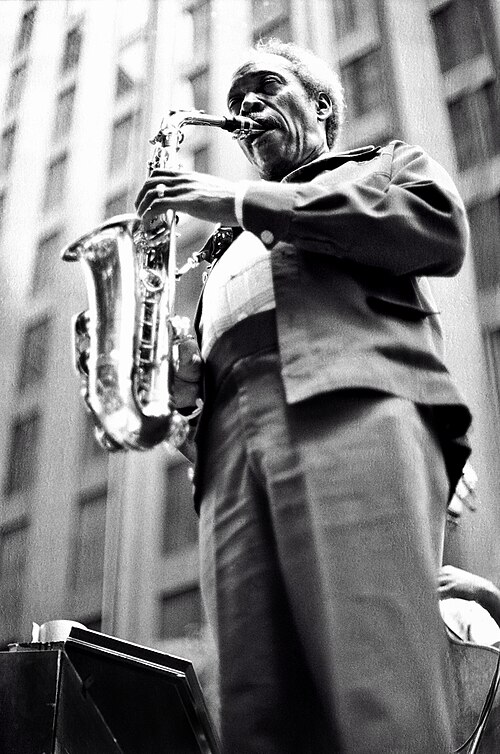
Tenor saxophone solo · 1949
Sonny Stitt: Elora
- Key
- B♭ major
- Tempo
- 193 BPM UP
- Rhythm feel
- Swing
- Style
- Bebop
- Choruses
- 1
- Form
- A8A8B8C8
Sonny Stitt's solo on “Elora” has 226 notes in 39 seconds (5.8 notes per second), spanning 23 semitones from Eb3 to D5. The average tempo is 193 BPM with a swing feel. About 62% of the melodic motion is stepwise (one or two semitones).
Notes
226Notes
39sSolo length
5.8Notes per second
Eb3–D5Range (23 semitones)
62%Stepwise motion
Pitch-class distribution
C
C♯
D
E♭
E
F
F♯
G
A♭
A
B♭
B
Most frequent intervals
- +2 ×40
- -1 ×39
- -2 ×32
- +1 ×28
- +3 ×19
- -3 ×19
Changes played over
A1
A2
B1
A3
I1
Record
- Record
- Quadromania Jazz Edition, Sonny Stitt, One O'Clock Jump, CD 1 · Membran Music Ltd. · 2005
- Recorded
- 1949-10-17
- Line-up
- Sonny Stitt (ts); J.J. Johnson (tb); John Lewis (p); Nelson Boyd (b); Max Roach (dr)
- Composer
- J.J. Johnson
- Solo length
- 00:50-01:29
Source: Weimar Jazz Database, Jazzomat Research Project (HfM Weimar), ODbL 1.0.