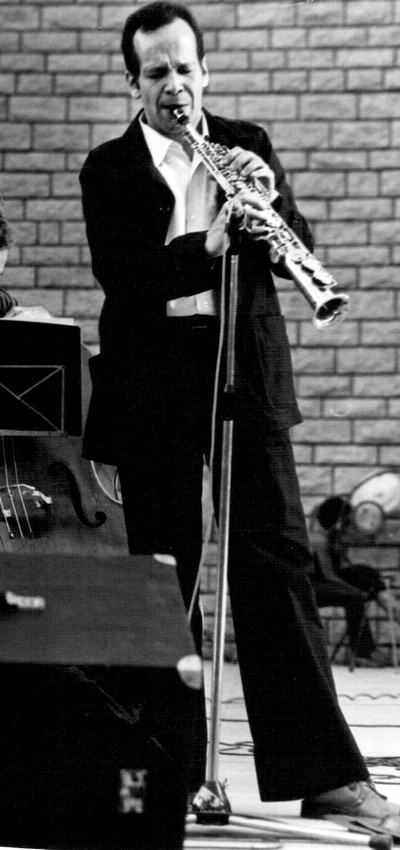
Soprano saxophone solo · 1957
Steve Lacy: Easy to Love
- Key
- G major
- Tempo
- 166 BPM MEDIUM UP
- Rhythm feel
- Swing
- Style
- Hardbop
- Choruses
- 4
- Form
- A16A16
Steve Lacy's solo on “Easy to Love” has 697 notes in 188 seconds (3.7 notes per second), spanning 32 semitones from G3 to Eb6. The average tempo is 166 BPM with a swing feel. About 38% of the melodic motion is stepwise (one or two semitones).
Notes
697Notes
188sSolo length
3.7Notes per second
G3–Eb6Range (32 semitones)
38%Stepwise motion
Pitch-class distribution
C
C♯
D
E♭
E
F
F♯
G
A♭
A
B♭
B
Most frequent intervals
- -1 ×77
- -4 ×76
- +3 ×73
- +2 ×69
- -2 ×65
- -3 ×62
Changes played over
A1
A2
Record
- Record
- Steve Lacy featuring Roswell Rudd, Don Cherry, Carl Brown, Bill Higgins, Winton Kelly, Buell Neidlinger, Dennis Charles and Henry Grimes · Giants of Jazz · 1995
- Recorded
- 1957-11-01
- Line-up
- Steve Lacy (ss); Wynton Kelly (p); Buell Neidlinger (b); Dennis Charles (dr)
- Composer
- Cole Porter
- Solo length
- 00:55-04:02
Source: Weimar Jazz Database, Jazzomat Research Project (HfM Weimar), ODbL 1.0.