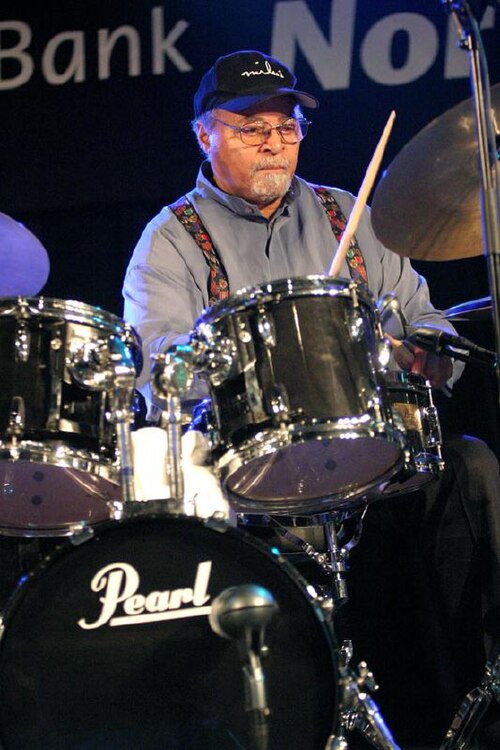
Jimmy Cobb
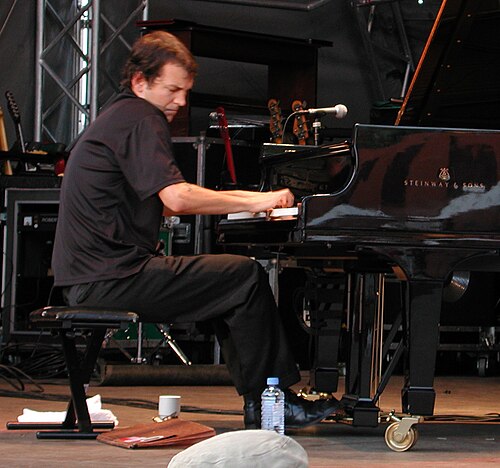
Foto: Tom Beetz @ http://home.hetnet.nl/~tbeetz/index.html, CC BY 2.0, via Wikimedia Commons

Batteristi · 1929–2020

Jimmy Cobb

Batterista statunitense (1929-2020)

Nascita
20 gennaio 1929
Washington D.C.
Morte
24 maggio 2020
Manhattan
Paese
Stati Uniti
Attività
1949–
Etichette
Chesky Records
Discografia
7 album

Biografia

Jimmy Cobb è stato un musicista jazz (batteria). Nato il 20 gennaio 1929 a Washington D.C., morto il 24 maggio 2020 a Manhattan. Lo stile è di solito associato a jazz. Etichette: Chesky Records. La discografia qui comprende 7 album, da «So Nobody Else Can Hear» (1983) a «This I Dig of You» (2019). Tra i riconoscimenti: NEA Jazz Masters.

Jimmy Cobb (Washington, 20 gennaio 1929 – New York, 24 maggio 2020) è stato un batterista jazz statunitense. Vantava collaborazioni con Dizzy Gillespie, John Coltrane, Stan Getz e Miles Davis. Il suo nome è legato soprattutto alla sua militanza nel gruppo di Miles Davis con il quale ha partecipato ad alcune storiche registrazioni: Kind of Blue, Sketches of Spain, Someday My Prince Will Come, Live at Carnegie Hall, Live at the Blackhawk, Porgy and Bess e Sorcerer. Jimmy Cobb è stato attivo a New York con il suo gruppo Jimmy Cobb's Mob. Ha insegnato nel 2006 e 2007 ai seminari del Tuscia in Jazz Festival. Nel 2008 ha insegnato al seminario We Love Jazz tenutosi presso Castagnole Piemonte, Torino.

Leggi la voce completa su Wikipedia ↗ · Da Wikipedia, l'enciclopedia libera (CC BY-SA 4.0)

Discografia

Album in studio e dal vivo

Suona anche in

Album in cui Jimmy Cobb compare come sideman

1955 For Those in Love — Dinah Washington drums (drum set)
1957 Sophisticated Swing — Julian “Cannonball” Adderley drums (drum set)
1958 Porgy and Bess — Miles Davis drums (drum set)
1958 Jump for Joy — Julian Cannonball Adderley drums (drum set)
1958 Cannonball’s Sharpshooters — Cannonball Adderley drums (drum set)
1959 Kind of Blue — Miles Davis drums (drum set)
1959 Cannonball Takes Charge — Cannonball Adderley drums (drum set)
1959 Kelly Blue — Wynton Kelly drums (drum set)
1959 Autumn Leaves — Wynton Kelly drums (drum set)
1959 Go — Paul Chambers drums (drum set)
1959 Blue Spring — Kenny Dorham Septet & Cannonball Adderley drums (drum set)
1960 Sketches of Spain — Miles Davis drums (drum set)
1960 Giant Steps — John Coltrane drums (drum set)
1960 Introducing Wayne Shorter — Wayne Shorter drums (drum set)
1960 Kelly At Midnite — Wynton Kelly drums (drum set)
1960 Gettin’ Together! — Art Pepper drums (drum set)
1960 That's Right! Nat Adderley and the Big Sax Section — Nat Adderley drums (drum set)
1960 This Here Is Bobby Timmons — Bobby Timmons drums (drum set)
1960 Out of the Blue — Sonny Red drums (drum set)
1961 Coltrane Jazz — John Coltrane drums (drum set)
1961 Cannonball Enroute — Julian “Cannonball” Adderley drums (drum set)
1961 Wynton Kelly! — Wynton Kelly drums (drum set)
1961 Rah — Mark Murphy drums (drum set)
1961 Sharp Edge — Howard McGhee drums (drum set)
1961 Soft Winds: The Swinging Harp of Dorothy Ashby — Dorothy Ashby drums (drum set)
1961 The Mode — Sonny Red drums (drum set)
1962 Standard Coltrane — John Coltrane drums (drum set)
1962 Full House — Wes Montgomery drums (drum set)
1962 Soul Trombone — Curtis Fuller drums (drum set)
1962 Images — Sonny Red drums (drum set)

Insegnante di

Premi

Domande frequenti

Che strumento suonava Jimmy Cobb?

Jimmy Cobb è noto per batteria.

Quando e dove è nato Jimmy Cobb?

Jimmy Cobb è nato 20 gennaio 1929 a Washington D.C..

Quali sono gli album più noti di Jimmy Cobb?

Nel nostro archivio ci sono, tra gli altri, So Nobody Else Can Hear (1983), The Session (1995), Marsalis Music Honors Series: Jimmy Cobb (2006), Monk (2012) e The Original Mob (2014).

Collegamenti esterni

Dati raccolti da fonti aperte; vedi i riferimenti qui sotto. Hai trovato un errore? Scrivici.

Latest posts

  1. Evaluating Jazz Syncopation Sources and Rhythmic Analysis
  2. Instruments of Bossa Nova Essential Tools for the Sound
  3. Why Is Improv Important in Jazz and How It Defines the Genre
  4. How to Memorize Jazz Standards Efficiently
  5. What Is the Most Well-Known Jazz Standard and Why It Wins
  6. What Does the ø Symbol Mean in Jazz Theory
  7. Examples of Bebop Jazz and Essential Listening Tracks
  8. What Is a Basic Drumming Pattern Called and How It Works
  9. How to Ear Train Effectively for Better Musicianship
  10. How to Notate a Tritone Substitution in Jazz Charts