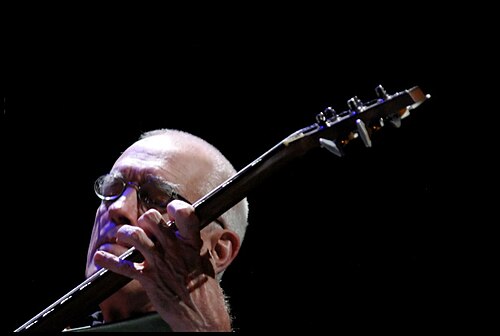
Nascita 4 ottobre 1940Fair Lawn
Attività 1960–
Discografia 17 album
Biografia
Steve Swallow è un musicista jazz (chitarra e basso). Nato il 4 ottobre 1940 a Fair Lawn. Lo stile è di solito associato a jazz e fusion. Etichette: Editions of Contemporary Music e Palmetto Records. La discografia qui comprende 17 album, da «Home» (1980) a «Winter Songs» (2026).
Steve Swallow (Fair Lawn, 4 ottobre 1940) è un bassista, contrabbassista e compositore statunitense, noto per le sue collaborazioni con Jimmy Giuffre, Gary Burton e Carla Bley. Swallow è conosciuto inoltre per essere stato uno dei primi contrabbassisti jazz a passare al basso elettrico.
Leggi la voce completa su Wikipedia ↗ · Da Wikipedia, l'enciclopedia libera (CC BY-SA 4.0)
Discografia Album in studio e dal vivo
Suona anche in Album in cui Steve Swallow compare come sideman
1963
Free Fall — Jimmy Giuffre double bass
1964
Footloose! — Paul Bley bass
1964
Point of Departure — Gary McFarland bass
1964
"Live" at the Half-Note — The Art Farmer Quartet feat. Jim Hall bass
1965
Basra — Pete La Roca bass
1967
In Paris Live — Stan Getz bass
1968
Tones for Joan's Bones — Chick Corea double bass
1969
Throb — Gary Burton bass
1971
Gary Burton & Keith Jarrett — Gary Burton & Keith Jarrett double bass, bass
1971
Good Vibes — Gary Burton bass
1971
Childhood Is Forever — Steve Kuhn bass
1972
Paris Encounter — Gary Burton & Stéphane Grappelli electric bass guitar
1974
Seven Songs for Quartet and Chamber Orchestra — Gary Burton / Michael Gibbs bass
1974
We Could Be Flying — Karin Krog, Steve Kuhn, Steve Swallow, Jon Christensen electric bass guitar
1974
In the Public Interest — Michael Gibbs & Gary Burton bass
1974
Ring — Gary Burton Quintet & Eberhard Weber electric bass guitar
1975
Work of Art — Art Farmer bass
1975
Hotel Hello — Gary Burton / Steve Swallow performer, bass, strings
1975
Trance — Steve Kuhn electric bass guitar
1976
The Best of Two Worlds — Stan Getz feat. João Gilberto bass
1977
Sheila — Sheila Jordan and The Johnny Knapp Trio bass
1977
Passengers — The Gary Burton Quartet with Eberhard Weber bass guitar
1978
Times Square — Gary Burton bass guitar
1978
Unexpected — Kenny Davern, Steve Lacy, Steve Swallow, Paul Motian bass guitar
1980
Bar Talk — John Scofield electric bass guitar
1981
Social Studies — Carla Bley bass
1982
Shinola — John Scofield electric bass guitar
1982
Live! — Carla Bley bass guitar, bass
1983
Mortelle randonnée — Carla Bley bass, synthesizer
1983
Something There — Michael Mantler bass
Standard scritti da Steve Swallow
Ascolta su Spotify
Carica il player di Spotify Domande frequenti
Che strumento suona Steve Swallow? Steve Swallow è noto per chitarra e basso.
Quando e dove è nato Steve Swallow? Steve Swallow è nato 4 ottobre 1940 a Fair Lawn.
Quali sono gli album più noti di Steve Swallow? Nel nostro archivio ci sono, tra gli altri, Home (1980), Swallow (1992), Real Book (1994), Carla (1997) e Deconstructed (1997).
Collegamenti esterni
Dati raccolti da fonti aperte; vedi i riferimenti qui sotto. Hai trovato un errore? Scrivici.