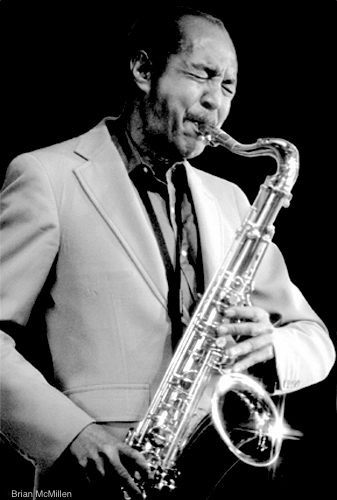
Harold Land
Foto: Brianmcmillen, CC BY-SA 4.0, via Wikimedia Commons

Saxophonisten · 1928–2001

Harold Land

US-amerikanischer Tenorsaxophonist und Komponist

Geboren
18. Februar 1928
Houston
Gestorben
27. Juli 2001
Los Angeles
Land
Vereinigte Staaten
Plattenlabels
Atlantic Records, Contemporary Records
Diskografie
15 Alben

Biografie

Harold Land war ein Jazzmusiker (Saxophon und Tenorsaxophon). Harold Land wurde am 18. Februar 1928 in Houston geboren und starb am 27. Juli 2001 in Los Angeles. Stilistisch wird die Musik meist Jazz zugeordnet. Plattenlabels: Atlantic Records und Contemporary Records. Die Diskografie umfasst hier 15 Alben, von „Harold in the Land of Jazz“ (1958) bis „A New Shade of Blue“ (2017).

Harold de Vance Land (* 18. Dezember 1928 in Houston, Texas; † 27. Juli 2001 in Los Angeles, Kalifornien) war ein US-amerikanischer Jazz-Tenorsaxophonist und Komponist.

Den vollständigen Artikel auf Wikipedia lesen ↗ · Aus Wikipedia, der freien Enzyklopädie (CC BY-SA 4.0)

Diskografie

Studio- und Livealben

Spielt außerdem auf

Alben, auf denen Harold Land als Sideman mitwirkt

1954 Dinah Jams — Dinah Washington tenor saxophone
1954 Jam Session — Clifford Brown, Max Roach, Harold Land, Richie Powell, George Morrow, Herb Geller, Keter Betts, Junior Mance, Clark Terry, Maynard Ferguson, Dinah Washington tenor saxophone
1954 Barney Kessel — Barney Kessel tenor saxophone
1956 Barney Kessel, Volume 1: Easy Like — Barney Kessel tenor saxophone
1957 On Vibes — Vic Feldman tenor saxophone
1957 Fire in the West — Herb Geller tenor saxophone
1958 El Tigre — Barney Kessel - Harold Land tenor saxophone
1958 Exploring the Future — Curtis Counce Quintet tenor saxophone
1960 Montgomeryland — Monk Montgomery, Wes Montgomery, Buddy Montgomery, Harold Land, Pony Poindexter, Louis Hayes, Tony Bazley tenor saxophone
1960 The Swingin' Nutcracker — Shorty Rogers saxophone
1960 Wiggin' Out — Gerald Wiggins tenor saxophone
1961 For Real! — Hampton Hawes tenor saxophone
1963 Yesterday’s Love Songs / Today’s Blues — Nancy Wilson reeds
1963 Conflict — Jimmy Woods Sextet feat. Elvin Jones tenor saxophone
1965 Chic* Chic Chico — Chico Hamilton tenor saxophone
1967 Virgo Vibes — Roy Ayers tenor saxophone
1968 Total Eclipse — Bobby Hutcherson tenor saxophone, flute
1970 Now! — Bobby Hutcherson tenor saxophone
1971 San Francisco — Bobby Hutcherson featuring Harold Land tenor saxophone, oboe, flute
1972 Ethiopian Knights — Donald Byrd tenor saxophone
1972 Universe — Hampton Hawes tenor saxophone
1974 Cirrus — Bobby Hutcherson woodwind
1975 Stratosonic Nuances — Blue Mitchell tenor saxophone
1976 Blues for a Hip King — Dollar Brand tenor saxophone
1977 Quintessence — Bill Evans, Harold Land, Kenny Burrell, Ray Brown & Philly Joe Jones tenor saxophone
1977 African Violet — Blue Mitchell tenor saxophone
1978 Red Alert — Red Garland tenor saxophone
1979 Bra Joe From Kilimanjaro — Abdullah Ibrahim (Dollar Brand) tenor saxophone
1979 Fever — Roy Ayers piano
1979 Spiral — Bobby Hutcherson tenor saxophone

Häufige Fragen

Welches Instrument spielte Harold Land?

Harold Land ist bekannt für Saxophon und Tenorsaxophon.

Wann und wo wurde Harold Land geboren?

Harold Land wurde 18. Februar 1928 in Houston geboren.

Was sind die bekanntesten Alben von Harold Land?

In unserer Datenbank finden sich unter anderem Harold in the Land of Jazz (1958), Eastward Ho! Harold Land in New York (1960), The Fox (1960), West Coast Blues! (1960) und The Remarkable Carmell Jones (1961).

Weblinks

Daten aus offenen Quellen zusammengestellt; siehe Quellenangaben unten. Fehler entdeckt? Schreiben Sie uns.

Latest posts

  1. How to Create Jazz Music A Practical Approach to Crafting
  2. How to Choose Jazz Scales with Practical Examples
  3. What Is a Jazz Lead Sheet and How Do Musicians Use It
  4. Evaluating Jazz Syncopation Sources and Rhythmic Analysis
  5. Instruments of Bossa Nova Essential Tools for the Sound
  6. Why Is Improv Important in Jazz and How It Defines the Genre
  7. How to Memorize Jazz Standards Efficiently
  8. What Is the Most Well-Known Jazz Standard and Why It Wins
  9. What Does the ø Symbol Mean in Jazz Theory
  10. Examples of Bebop Jazz and Essential Listening Tracks