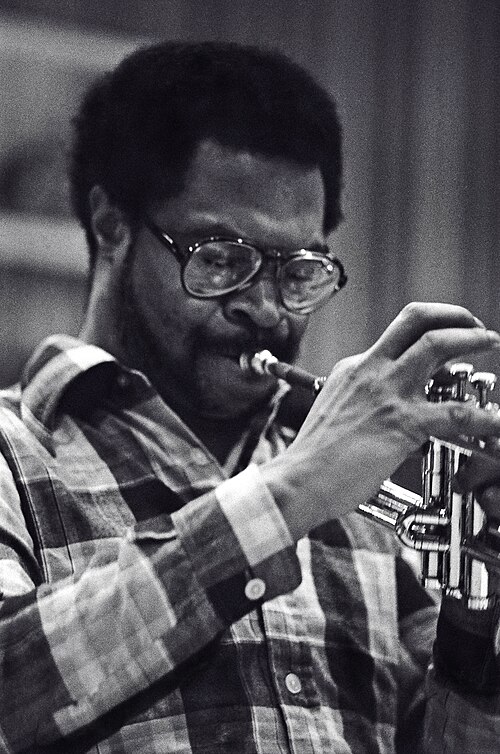
Cornet solo · 1978
Woody Shaw: Stepping Stone
- Key
- F major
- Tempo
- 266 BPM UP
- Rhythm feel
- Swing
- Style
- Postbop
- Choruses
- 1
- Form
- A16B16
Woody Shaw's solo on “Stepping Stone” has 160 notes in 29 seconds (5.4 notes per second), spanning 27 semitones from G3 to Bb5. The average tempo is 266 BPM with a swing feel. About 52% of the melodic motion is stepwise (one or two semitones).
Notes
160Notes
29sSolo length
5.4Notes per second
G3–Bb5Range (27 semitones)
52%Stepwise motion
Pitch-class distribution
C
C♯
D
E♭
E
F
F♯
G
A♭
A
B♭
B
Most frequent intervals
- +2 ×33
- -2 ×22
- -3 ×19
- -1 ×16
- 0 ×14
- +5 ×14
Changes played over
A1
B1
Record
- Record
- Stepping Stones: Live at the Village Vanguard · Columbia · 1978
- Recorded
- 05.&06.08.1978
- Line-up
- Woody Shaw (cor, flgn); Carter Jefferson (ts, ss); Onaje Allan Gumbs (p); Clint Houston (b); Victor Lewis (dr)
- Composer
- Woody Shaw
- Solo length
- 00.54-01:25
Source: Weimar Jazz Database, Jazzomat Research Project (HfM Weimar), ODbL 1.0.